


Ads in AI: the death of impartiality?
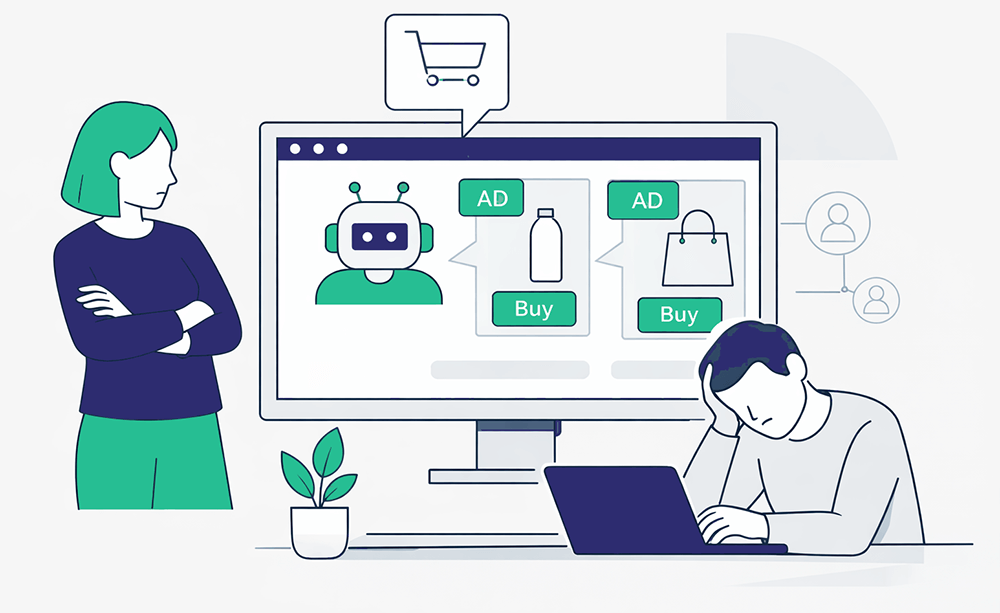
What happens when the tool you trust for neutral answers starts recommending products?
AI tools like ChatGPT are, for many people, becoming the main interface for finding information, making decisions, and getting work done. As adoption grows, so do the costs of running advanced models. OpenAI, as a high-profile example, burns through an estimated $17 billion per year. Now advertising is entering the picture, raising a fundamental question: can AI remain trusted if it becomes ad-supported?
Some companies believe advertising is necessary for scale. Others argue it risks damaging the credibility that makes these tools worth using in the first place. Here is the case on both sides.
Why advertising in AI makes sense
Running large language models is expensive. Training, infrastructure, and ongoing usage cost hundreds of millions of dollars each year. Subscription revenue alone may not cover long-term demand, particularly for companies that want to offer free access to as many people as possible.
OpenAI has begun testing adverts in ChatGPT for free users. These placements are clearly labelled and appear within the chat interface, with the stated aim of supporting operating costs without placing the full burden on paying subscribers. Early advertiser partners include Target, Adobe, and Ford, all of which see value in reaching users while they are actively asking questions or completing tasks.
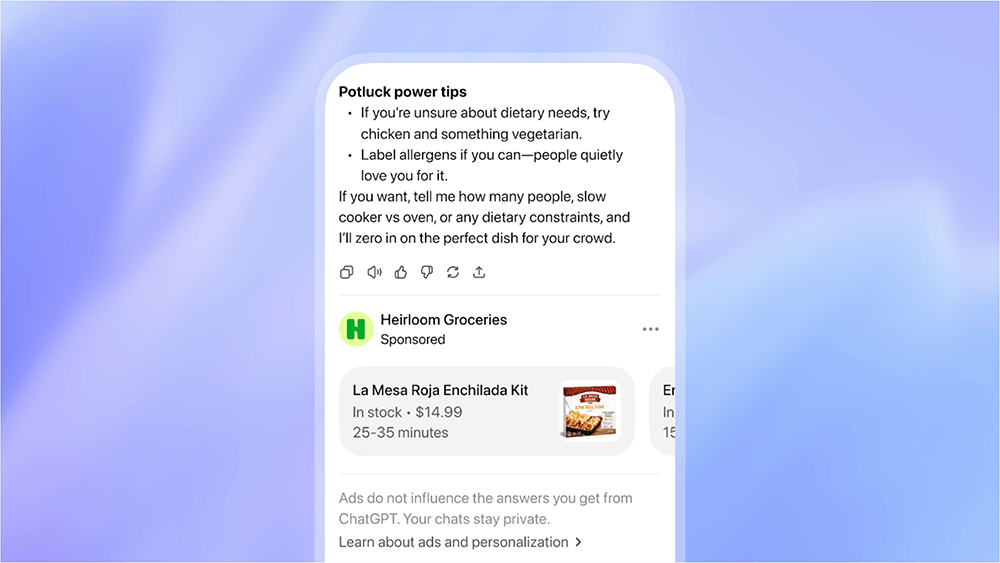
Image source: OpenAI
There is also an economic accessibility argument. If ad revenue supports a free or lower-cost tier, more people can use AI tools without paying subscription fees. Students, job seekers, and small businesses stand to benefit most from that arrangement.
AI also opens up genuinely new advertising formats. Instead of static banners, conversational ads could respond directly to user intent. Someone asking about travel plans might see relevant hotel offers. A user designing a logo might be introduced to creative software. In theory, this increases relevance and reduces wasted impressions for advertisers and users alike.
Conversational advertising could be the most contextually relevant ad format ever built. The question is whether users will accept it inside a tool they trust for honest answers.
The concerns about adverts in AI
Trust and neutrality are central to the appeal of AI assistants. That is precisely what makes advertising such a sensitive issue here.
Perplexity removed advertising after testing, citing concerns that ads could undermine trust in factual and unbiased responses. Anthropic has publicly pledged that Claude will remain ad-free and has promoted this position as a differentiator, making the contrast with competitors explicit in its Super Bowl advertising.
Critics argue that advertising may shift priorities toward commercial interests rather than accuracy and quality. If a platform earns revenue from sponsors, users will reasonably question whether recommendations are fully impartial. Academic research has suggested that even the perception of advertising influence within AI conversations can damage trust, regardless of whether the ads are clearly labelled.
Privacy is another significant concern. Users may worry that their queries are being analysed to personalise adverts, particularly when asking sensitive questions about health, finances, or personal circumstances. The backlash against targeted advertising on social networks and search engines is a warning the industry would be unwise to ignore.
Some users, myself included, believe conversational tools should remain ad-free altogether. The frustration with intrusive advertising that has built up over two decades of social media and search is real, and AI assistants have so far avoided it. That is worth something.
We have already seen what happens when advertising becomes the primary business model for tools people rely on daily. The incentives shift, and over time, so does the product.
Where the industry stands now
Different companies are taking meaningfully different approaches. OpenAI is actively testing adverts in ChatGPT to support free access. Anthropic’s Claude and Perplexity are both positioning ad-free experiences as a core part of their value proposition. Google’s Gemini has not announced advertising plans at this stage, though it sits within a company whose entire business is built on ad revenue, which is a situation worth watching.
The industry is still in early experimentation. It is likely that both ad-supported and ad-free models will coexist for the foreseeable future.
What this means
Advertising can make AI more economically accessible and create new revenue streams that keep capable models free to use. It may also enable conversational ad formats that feel more relevant than anything that came before.
The counterargument is equally strong. Advertising can erode trust, raise privacy concerns, and alter perceptions of neutrality in ways that are difficult to reverse. Because AI assistants operate as reasoning partners rather than simple search engines, the stakes are considerably higher than they were for web search.
The outcome may depend less on whether ads appear at all, and more on how transparently and carefully they are implemented. But transparency and commercial incentive do not always travel well together. The industry will need to watch that carefully.
Frequently asked questions
- Does ChatGPT show adverts?
OpenAI has begun testing adverts in ChatGPT for free-tier users. The placements are labelled and appear within the chat interface. This is currently being trialled rather than rolled out universally. - Does Claude show adverts?
No. Anthropic has publicly committed to keeping Claude ad-free and has positioned this as a deliberate strategic choice rather than a temporary one. - Can advertising affect the neutrality of AI responses?
Research suggests that even the perception of advertising involvement can reduce trust in AI responses, regardless of whether individual answers are actually influenced. Transparency about ad placement helps, but does not fully resolve the concern. - Why are AI companies considering advertising?
The cost of running large language models is substantial. Advertising offers a revenue model that can support free-tier access without relying entirely on subscriptions, which makes it commercially attractive despite the trust implications. - What is the alternative to ad-supported AI?
Subscription models, enterprise licensing, and API pricing are the main alternatives. Some providers also explore revenue sharing with developers who build on their platforms. Each model involves trade-offs between accessibility, cost, and the incentives it creates.
Interested in more content like this? Sign up to our Newsletter here.
How we can help
At iwantmore.ai, we specialise in helping businesses bridge the AI divide turning curiosity into capability and capability into competitive advantage.
We work with organisations to:
- Assess AI readiness: Understand where you are today across people, processes, and platforms.
- Identify high-impact use cases: Through discovery workshops and hands-on collaboration, we surface the areas where AI and automation can add the most value specific to your business.
- Design and implement practical solutions: From AI agents to process automation, we help you build solutions that deliver real business outcomes not just tech demos.
Whether you’re just starting out or looking to take your existing efforts to the next level, we’re here to guide you every step of the way.
We understand you are busy but don’t get left behind. Start your AI journey with confidence. Contact us and let’s explore what’s possible for your business.
Other AI articles you may be interested in:

Vibe marketing is the next big thing in digital marketing. But what is Vibe Marketing? Vibe marketing is a new approach that uses generative AI to translate a brand feeling or essence into marketing assets (images, copy, ads, full campaigns, and even product ideas). Coined from the concept of vibe coding, introduced by AI legend Andrej Karpathy, vibe marketing is all about marketers describing their brand’s feel, audience, and intention in plain English.
AI continues to move forwards at a ridiculous pace. New models are popping up weekly. Things you couldn’t do a week ago now seem second nature. But behind the headlines about innovation, is good old regulation. Whether it’s GDPR or new legal frameworks emerging to tackle foundation models, in the UK, AI won’t remain unregulated for long.
In the world of artificial intelligence, there's a slightly corny phrase that gets repeated a lot: ‘data is the new oil.’ I don’t like it, but it’s catchy. It makes a point. But like all catchy phrases, it oversimplifies reality. Yes, data fuels AI, but does that mean you need to stop everything until your data is pristine? Nope.
At iwantmore.ai, we help businesses navigate the world of AI. One of the persisting challenges we see is the perception by some people that using AI is 'cheating.' Despite AI’s proven advantages, some professionals still feel uneasy about embracing it leading to a culture where employees secretly use AI tools to avoid judgment.
Every company seems to want to use AI. According to Cisco’s second annual AI readiness report, 98% of executives felt an increased urgency to deliver on AI. Many businesses are already implementing it in some way, but based on the findings of the RAND report, more than 80% of AI projects fail.
Every few days, a new AI model seems to drop from one of the big AI companies. But as a normal person, how do you work out whether a new AI model is actually better than what you were using before? In this article we look at ways in which you can test out which model is most applicable for your business needs.


iwantmore.ai – The AI consulting firm that helps you build a smarter business
Wherever you are with your AI implementation initiatives, we have a range of stand-alone AI quick start services to help you fast track the transformative benefits of AI across your business.
